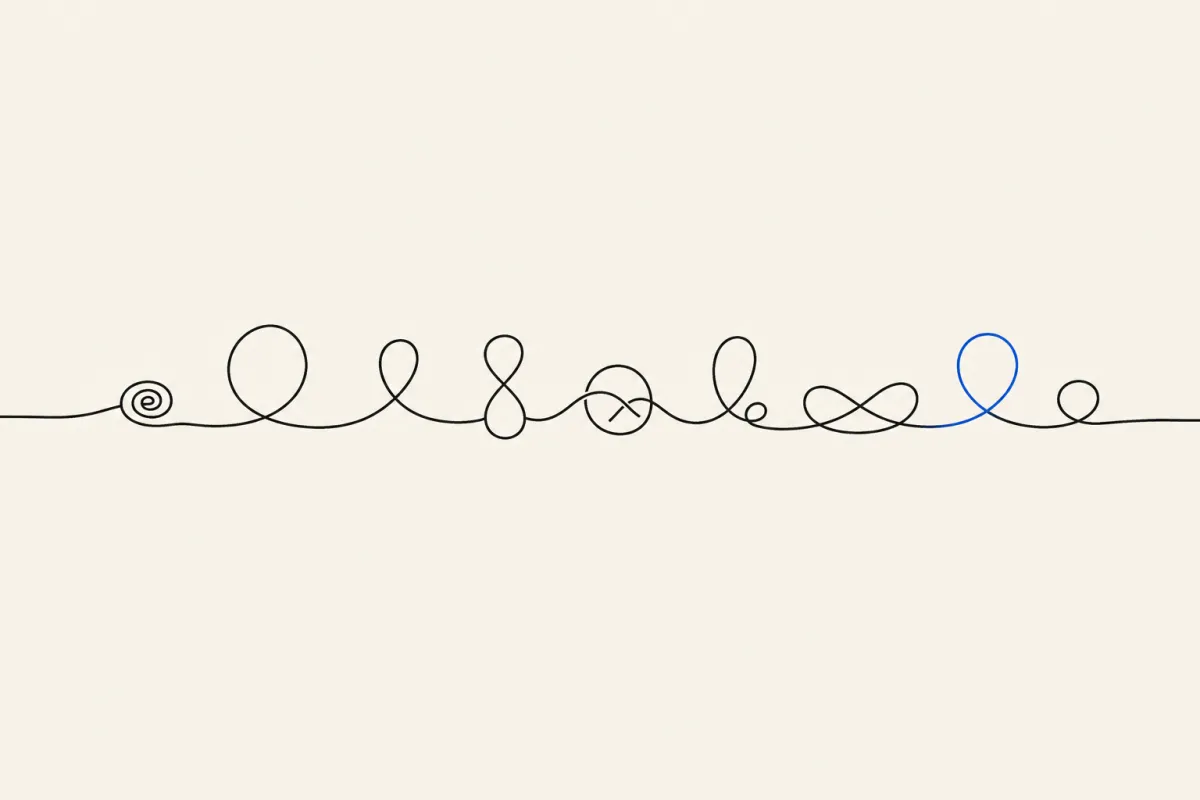
The 10 Loops
A field guide to the patterns that keep capable people stuck.
A loop is a pattern that fires faster than thinking: a trigger, an automatic move, a payoff you collect today, and a cost you don't price in. I wrote about the mechanics in The Execution Gap. This is the field guide -- the ten shapes I see over and over in senior operators, founders, and people who execute brilliantly for everyone but themselves.
Most people run two or three. One is usually load-bearing.
The names matter more than they seem. A pattern you can name is a pattern you can catch mid-fire; a pattern with no name just feels like your personality. So read the list the way you'd read a field guide: not to memorize all ten, but to recognize the one that's been running you.
1. The more-research loop
You convert every decision into a research project, because gathering feels like progress and deciding feels like risk. The tell: your bookmarks outnumber your actions a hundred to one, and the next article always feels load-bearing. The payoff is real -- you genuinely know more. The cost is that knowing was never the constraint.
2. The competence refuge
You retreat into work you're brilliant at to avoid a decision you're not sure of. The hard call appears; you drop into the dashboard, the refactor, the deck. By the end of the day you've been impressively productive at everything except the one thing. Excellence becomes the most respectable hiding place you'll ever find.
3. The quit-or-stay oscillation
You swing between leaving and committing without doing either, because the swing itself relieves the pressure of choosing. Monday you're drafting the resignation; Thursday you're recommitting for the year. The oscillation feels like deliberation. It's actually a holding pattern -- both options stay alive so neither has to be paid for.
4. The calendar defense
You let a full calendar stand in for a made decision, because being busy is easier to defend than being wrong. Every block is justified; the sum is an alibi. The tell: you describe yourself as slammed, but the move that matters has never once appeared on the schedule.
5. The almost-ready loop
You stack one more credential, course, or skill in front of the move, because preparation feels like approach. Readiness becomes a horizon: it recedes at exactly the speed you advance. The tell: you were also "six months out" a year ago. Nobody who waited until they were ready can tell you what ready felt like.
6. The new-plan high
You rewrite the plan instead of running it, because a fresh plan delivers the feeling of progress without the exposure of action. Version four of the strategy; version zero of the move. The rewrite is genuinely pleasurable -- that's the trap. Plans don't fail you at this stage; they protect you.
7. The stakes inflation
You grow the move until it's too big to attempt, because if it has to be total, today is never the day. The modest version gets dismissed as not worth doing; the grand version requires conditions that don't exist yet. Going big sounds like ambition. Used this way, it's the most flattering form of never.
8. The permission audit
You poll mentors, peers, and threads for a green light nobody else can issue, because advice is a respectable substitute for deciding. The tell: you already know what you'd say to someone else in your position; you've said it to several. Another opinion isn't information anymore. It's a deferral with good manners.
9. The fresh-start deferral
You park the move behind a clean boundary -- Monday, the first, after the quarter, after the reorg -- because starting mid-mess feels wrong. The boundary arrives; a new mess has replaced the old one; a new boundary forms. The calendar is endlessly generous with fresh starts. That's what makes it such a reliable accomplice.
10. The silent renegotiation
You quietly shrink the move until it no longer scares you -- and no longer changes anything. The conversation becomes an email; the leap becomes a side project; the decision becomes a "direction." You never quit, so there's nothing to grieve. There's also nothing to show.
The one that runs you
Reading a list like this, most people nod at four or five and feel mildly clever. That's not the useful reaction. The useful reaction is the wince -- the one entry that reads less like a description and more like surveillance.
That one. Not the three you can discuss comfortably at dinner; the one you'd rather rename into something more flattering. The loop that runs you is almost always the one wearing your best quality as a disguise: your rigor (more research), your excellence (the refuge), your ambition (stakes inflation), your prudence (the permission audit).
A name won't break it. But a loop you've named is a loop you can catch in the act -- and everything that actually changes starts in that half-second of recognition.